Product Overview
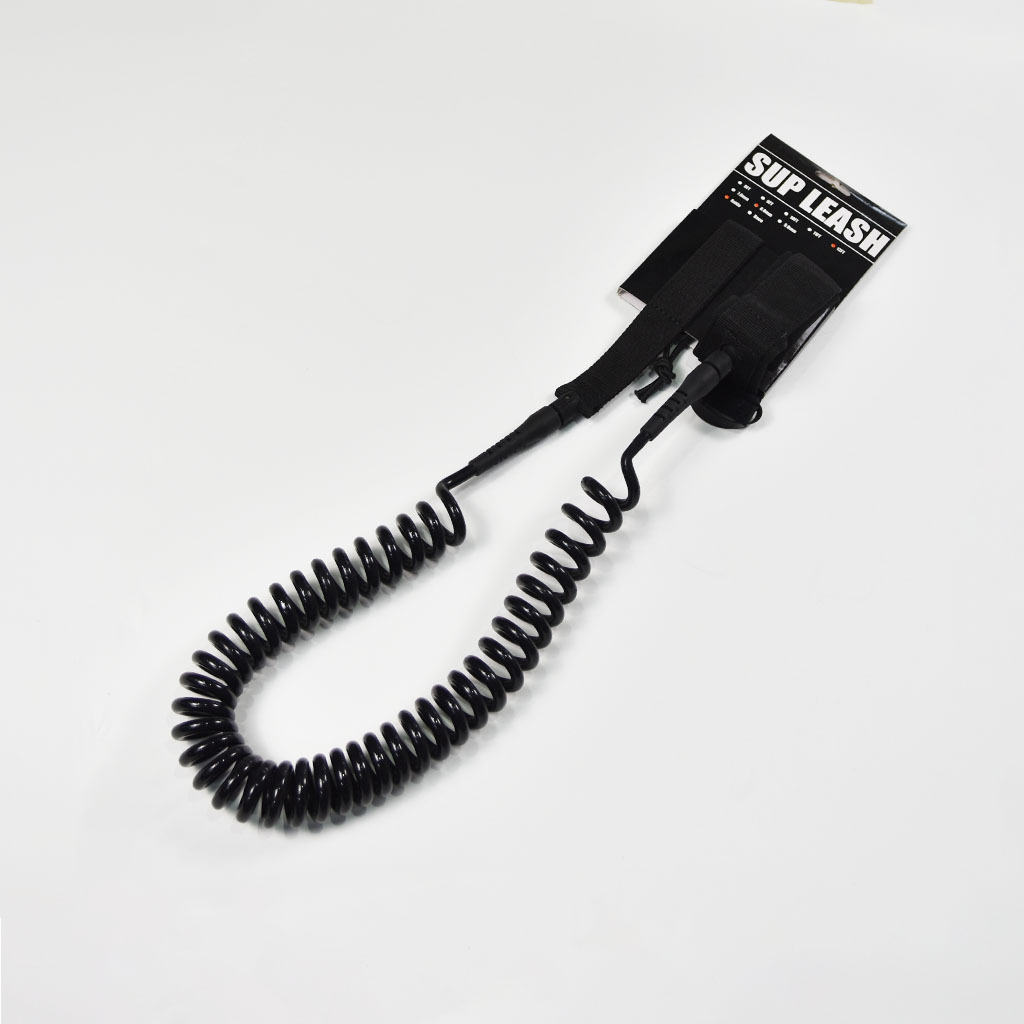
The 12-foot SUP leash is the longest ankle-cuff model CIMI builds, sized for full-length stand-up boards. A twelve-foot cord gives a paddler room to walk the deck, step back to the tail or swing the paddle without the leash pulling taut underfoot — and if you do go in, the board is still attached. The 8 mm sup leash cord is heavier than the 7-millimetre cords used on our shorter leashes. Most of these leave here as wholesale SUP leash stock — a stand up paddle leash for riders on 11-foot and 12-foot boards, where the deck is long and the rider is constantly changing position. Black throughout — matte webbing, glossy cord — so it sits quietly against any board graphic.
Cord, Cuff & Hardware
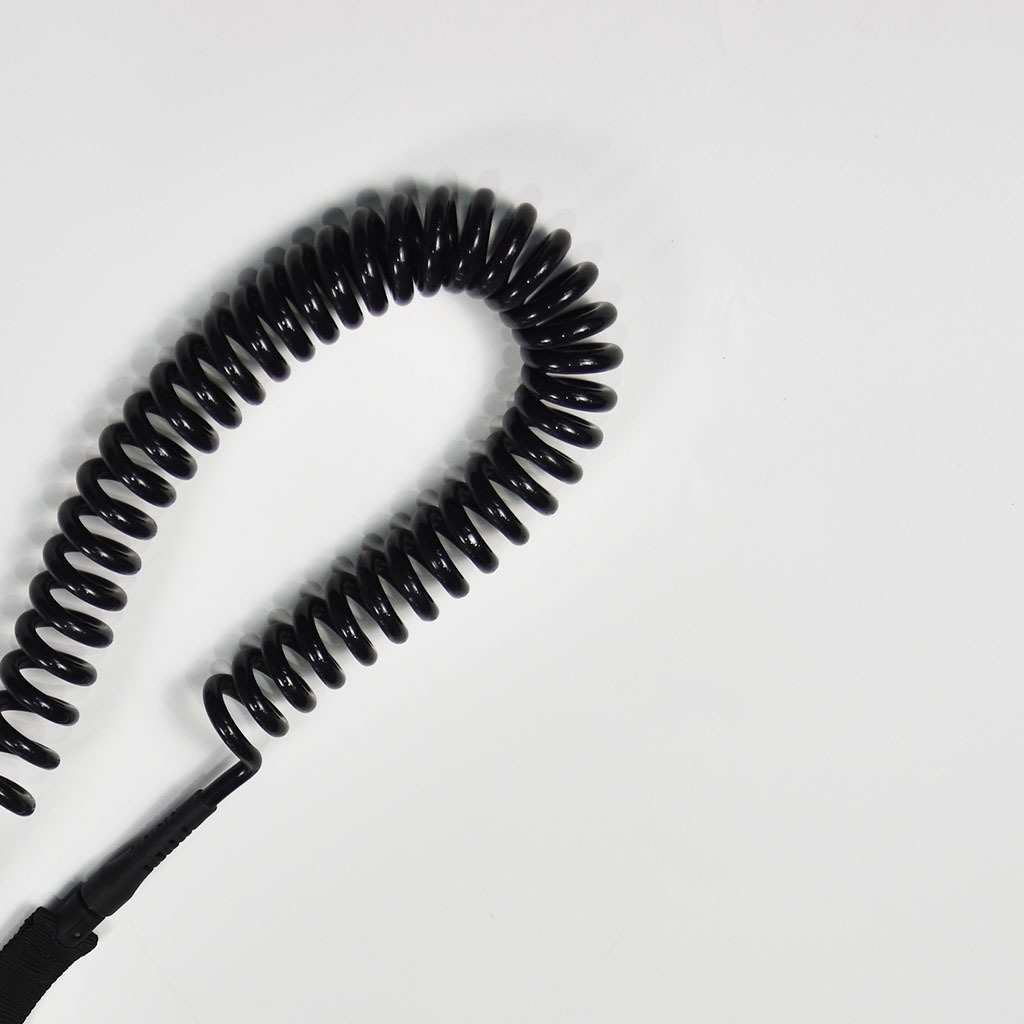
- Coiled cord — The 8-millimetre SUP leash cord is a TPU build with a coiled profile and a glossy black finish, so it gathers near the board when you are standing still and pays out as you step away.
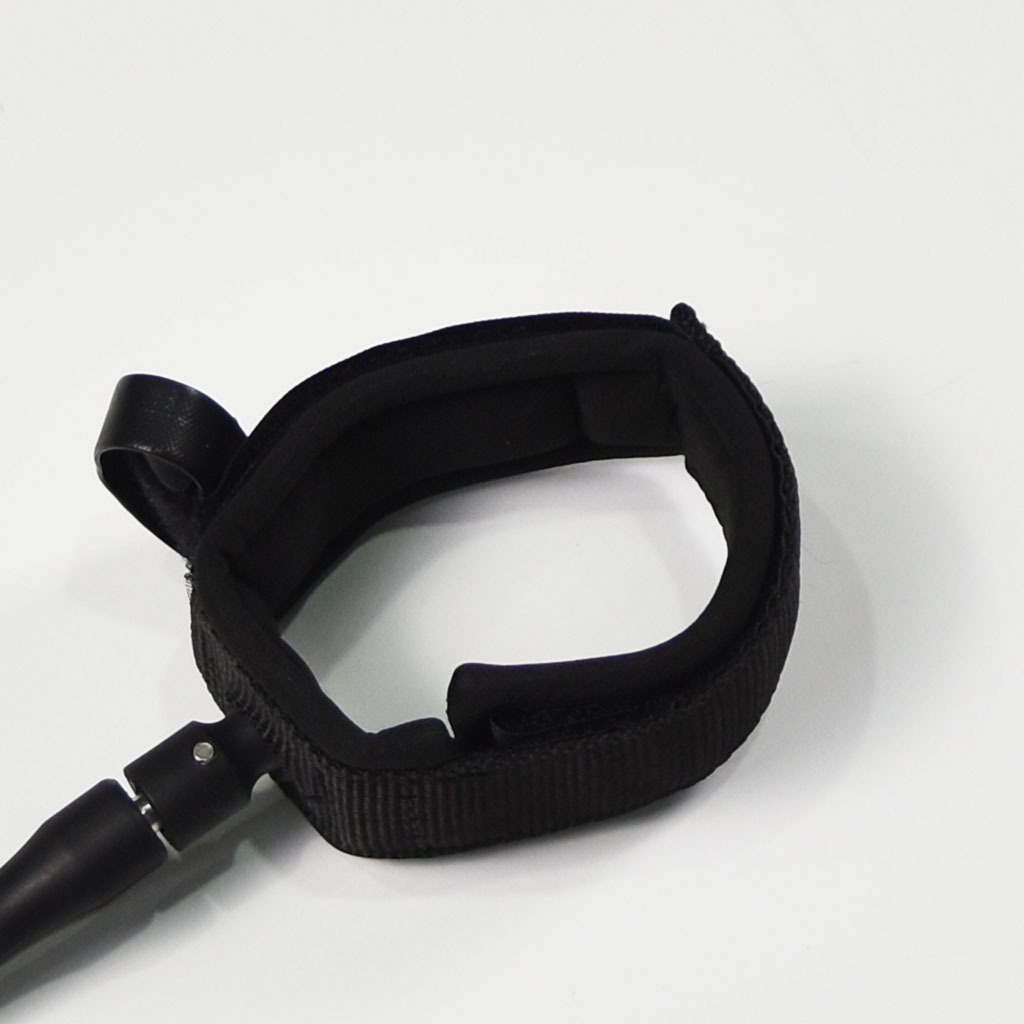
- Padded ankle cuff — Padding sits between the webbing and your ankle bone, with stitched edges and a strap that closes flat instead of bunching under the ankle.
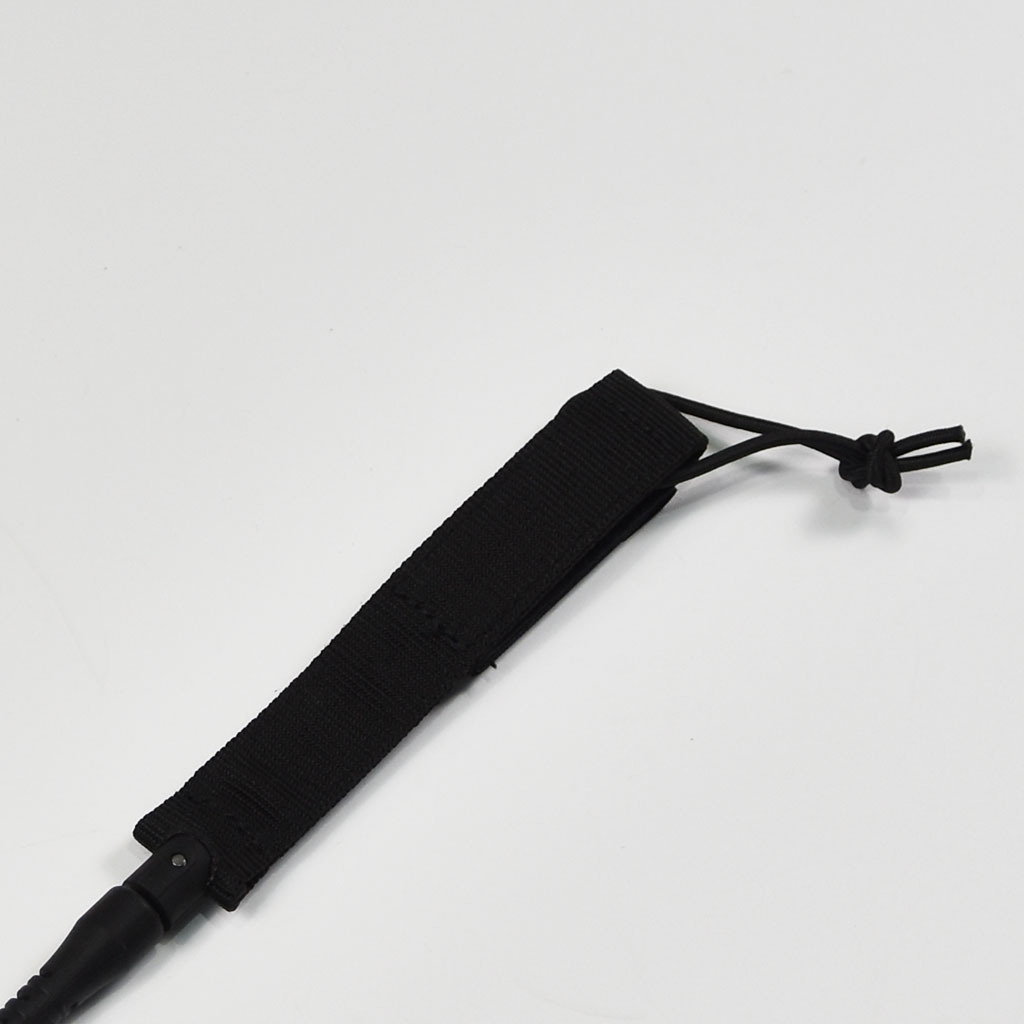
- Rail saver — A webbing strap at the board end takes the abrasion where the leash leaves the rail, keeping the cord itself clear of the board's edge.
- Swivel connector — A metal swivel joins cord to rail saver and lets the leash rotate with the board instead of loading the cord in one direction.
- Stitched webbing ends — Both ends are stitched and finished, and the loop at the rail-saver end stays open enough to thread easily when the leash is wet.
- Made in our own factory — As a sup leash manufacturer we assemble cord, cuff and rail saver ourselves, so the 12ft SUP leash you approve is the one you get on reorder.
- Built for repeat seasons — The parts that wear first get the most attention: a thicker cord, stitched webbing ends and a metal swivel, which together make it a durable sup leash for shops and fleets rather than a single-summer purchase.
Length & Board Fit
Twelve feet is a lot of leash, and it is the right amount for a board close to that length. Match the leash to the board rather than to the rider: on an 11 ft or 12 ft board, a shorter leash pulls tight the moment you step back to turn, and a taut leash is what brings a board back at you after a fall. The 12ft SUP leash keeps slack in the system through a full step-back and a pivot turn.
Boards under about 10 ft do not need the extra length. The 10 ft and 8 ft SUP ankle leash models use the same padded cuff and rail saver on shorter cords, and a shorter leash is easier to manage on a compact board. If one leash has to cover a 10 ft and a 12 ft board, buy for the 12 ft board: the extra length is harmless on the shorter one, while a 10 ft leash on a 12 ft board is not.
Where it suits — Flatwater and lake touring, coastal touring and downwind runs, small to moderate surf, and rental or school fleets running large boards, where the priority is simply that the board stays with the rider. It is a board-retention leash for paddling, not a heavy-water leash, and it is not intended for surf bigger than the board is built for.
Ankle & Knee Cuff Fit
- The attachment point is the whole difference on a 12-foot deck. An SUP ankle leash closes above the ankle bone and sits low on the leg, so nothing presses into the calf when a paddler drops to a knee to turn or climbs back on after a fall. A knee cuff closes just below the knee, where the strap has more surface to grip and less chance of rotating around a narrow ankle.
- Cord gauge follows the cuff in our range: the 12-foot knee build runs a 9-millimetre cord, while this 12-foot ankle model runs 8-millimetre. For touring paddlers who load the leash hard in chop and cross-wind, quote the thicker knee build; for lakes, flatwater and light surf, the 8-millimetre cord here is already the heaviest gauge in the ankle line.
- Choose the ankle cuff when the rider is on and off the board constantly, steps back to pivot, and swaps between flatwater and small surf in one session — the low profile stays clear of the deck when kneeling and out of the way of a boot cuff.
- Choose the knee cuff for cold-water paddlers in thick neoprene boots, for anyone with a prominent ankle bone or tender Achilles, and for long-distance tourers who hold the leg straight for hours. Sitting on the calf rather than on the joint takes the pressure off the spot that complains first.
- Fit checks are not the same. On the ankle, one finger should slide under the closed strap and the cuff should not rotate around the leg. On the knee build the strap needs to sit on the widest part of the calf below the knee, with the opening wide enough that the padding does not ride up when the leg flexes. Calf sizes vary far more than ankles, so as a custom SUP leash supplier we confirm the knee cuff opening with you before a fleet order.
- The 12-foot knee model is listed as L00329, with L00330, L00331 and L00333 as code variants of the same 12-foot 9-millimetre knee build. Keeping this L00339 ankle leash and the knee family on one 12-foot length lets a shop offer big-board paddlers the same reach with two attachment styles instead of sending them to a different length.
- Rental and school fleets usually lean on the knee cuff, because one strap height covers riders in bare legs, 3-millimetre booties and 5-millimetre boots without re-fitting at the water's edge. Dealer display walls do better with both: ankle for the paddler who wants minimum bulk, knee for the one who has tried an ankle strap and found it uncomfortable.
Fitting & Care Routine
- Thread the rail-saver webbing through the leash plug at the tail of the board — a stand up paddle leash mounts at the tail, never at the nose — using the board's own leash string if the plug needs one, then pull the cord loop through.
- Lay the rail saver flat along the rail and check it clears the fin box and any rail tape before you launch.
- Fasten the padded cuff above the ankle bone: snug enough that it cannot rotate around the leg, loose enough that one finger slides under the strap.
- Over a wetsuit boot, close the cuff on the boot rather than on bare skin; the strap has enough adjustment to sit over neoprene.
- Give the cord and the swivel a firm pull before you leave the beach. A durable SUP leash that is going to fail should fail in your hands, not half a kilometre offshore.
- Rinse the cuff, cord and swivel in fresh water after every saltwater session, then hang the leash to dry out of direct sun and off a hot deck.
- Check the cord where it meets the swivel and the stitching on both webbing ends every few sessions, and retire the leash once the cord is nicked or the webbing frays.
Range & Pairings
- Ankle models in other lengths — The 8-foot and 10-foot ankle builds use the same cuff, rail saver and swivel, so a shop that stocks the 8-millimetre SUP leash here can fill the rest of the ankle wall without introducing a second construction. - Hypalon-cuffed surf leashes — Lighter cuffs from 5-foot to 10-foot, for surfers who want less bulk at the ankle, sitting under the surf range rather than the SUP range. - Fins — Honeycomb, timber, G10 glass and nylon fins plus fin accessories, so a board can leave the shop set up rather than needing a second visit. - Traction pads — EVA tail pads, centre pads and waxless options; the other half of the board-and-grip sale. - Covers and racks — Basic bags, regular bags, stretch covers, travel racks, storage racks and display racks for shops that need boards protected and merchandised. - Board-and-leash bundles — Shops pair this with the touring boards on the floor; it is the durable SUP leash that matches the big-board customer, and bundling it at the point of sale saves a second trip.
Specifications
| Model | L00339 |
|---|
| Type | SUP ankle leash |
| Length | 12 ft (approx. 3.6 m) |
| Cord thickness | 8 mm |
| Cord | Coiled cord |
| Cuff | Padded ankle cuff with hook-and-loop closure |
| Board end | Webbing rail saver with swivel connector |
| Colour | Black |
| Intended use | Stand-up paddleboarding |
| Mounting point | Leash plug at the tail of the board |
Quality Control & Ordering
- Material check — Cord, webbing, cuff padding and swivel hardware are inspected against the approved specification before anything is cut; as a sup leash manufacturer we would rather reject a roll than explain a failure later.
- In-line checks — Cord attachment, cuff stitching and rail-saver webbing are checked as each leash moves through assembly, not just at the end of the line.
- Final inspection — Cuff closure, swivel action and stitch quality are signed off before the leash is packed.
- Configuration — Cuff branding, header card artwork, colour and carton marking are confirmed in writing before production is scheduled. We work from your artwork, a sketch or a drawing, and as a custom sup leash supplier we build a pre-production sample into the schedule so you see the finished piece before the run starts; your sales contact will confirm the sample terms that apply.
- Commercial terms — Volume, price, lead time, payment and delivery are agreed with your sales contact against that confirmed configuration, so the quotation matches what is built rather than what was assumed.
- Scheduling and export — Wholesale SUP leash orders are booked against your delivery date and shipped on the terms you agree with us; we supply brands, resellers and distributors across North America, Europe and Oceania, and more than 1,000 of them to date.
- Repeat orders — A reorder follows the same approved sample and specification as the first delivery, which is how a catalogue stays consistent from one season to the next.
- Volume and packing — Our pad line runs to 5,000 tail pads a month and leash production is scheduled on the same floor, so a full accessory buy can be planned together. Packaging stays reusable where your programme allows, and we are still reviewing lower-impact materials; tell us if that is a buying criterion and we will confirm what is possible for your order.
Scale & Supply Capability
CIMI is a factory-based supplier with 16 years in surf and watersports hardgoods, manufacturing at our own facility rather than sourcing through traders. Chain stores, supermarkets and surf-brand stores buy from us because one supplier covers a full accessory assortment, so a season's order and its reorders can be planned together. We take on OEM and private-label work, adapting designs, colourways and branding to your programme, and we schedule production against your agreed range plan. Send us your buy list and target dates, and we will confirm what we can make and when.
FAQ
Can one 12 ft leash cover both a 10 ft and a 12 ft board?
It can, but the 12 ft board sets the length. On the shorter board you simply carry a little extra cord; on the 12 ft board a 10 ft leash pulls tight as soon as you step back. If one length has to serve both, the 12ft SUP leash is the safer buy.
What is different between this and the 12 ft knee-cuff SUP leash?
Attachment and cord thickness. The knee model runs a 9-millimetre cord on a knee cuff; this SUP ankle leash runs an 8-millimetre cord on a padded ankle cuff. Both are 12-foot and share the same rail saver and swivel, so the choice comes down to whether you want the leash above the ankle or around it.
Can we put our own logo on the cuff and print our own header card?
Yes. Cuff branding, header card artwork, colour and carton marking are all part of a private-label run, and the artwork is confirmed in writing before production. As a custom sup leash supplier we build the sampling phase into the schedule, so you approve the finished piece rather than a description of it.
Is this only for stand-up paddleboards, or can it go on a surfboard?
It is a stand up paddle leash first. Twelve feet of cord is more than a surfboard needs, and the cuff is sized for a SUP session. For longboards, our surf leashes run from 5 ft to 10 ft in regular, hypalon and non-slip builds.
How does the 8 mm cord compare with your 7 mm leashes?
The 8-millimetre cord is the heavier of the two and appears across the SUP ankle range from 8-foot to 12-foot; the 7-millimetre cord is used where less bulk matters. As a sup leash manufacturer we build both from the same cord family, so the difference is gauge and the board it is matched to rather than a different grade of material. Where a fleet mixes both, the 8-millimetre SUP leash and the 7-millimetre models can be stocked side by side without confusing the range.
Can it be used as a tow line or to tie the board off?
No. This is a board-retention leash, not a tow line, anchor line or lifting sling, and it should never be used to pull a board, a rider or gear behind another craft. Used as intended, between your ankle and the tail plug, it is exactly the right product; used as rigging, it is the wrong one.