Product Overview
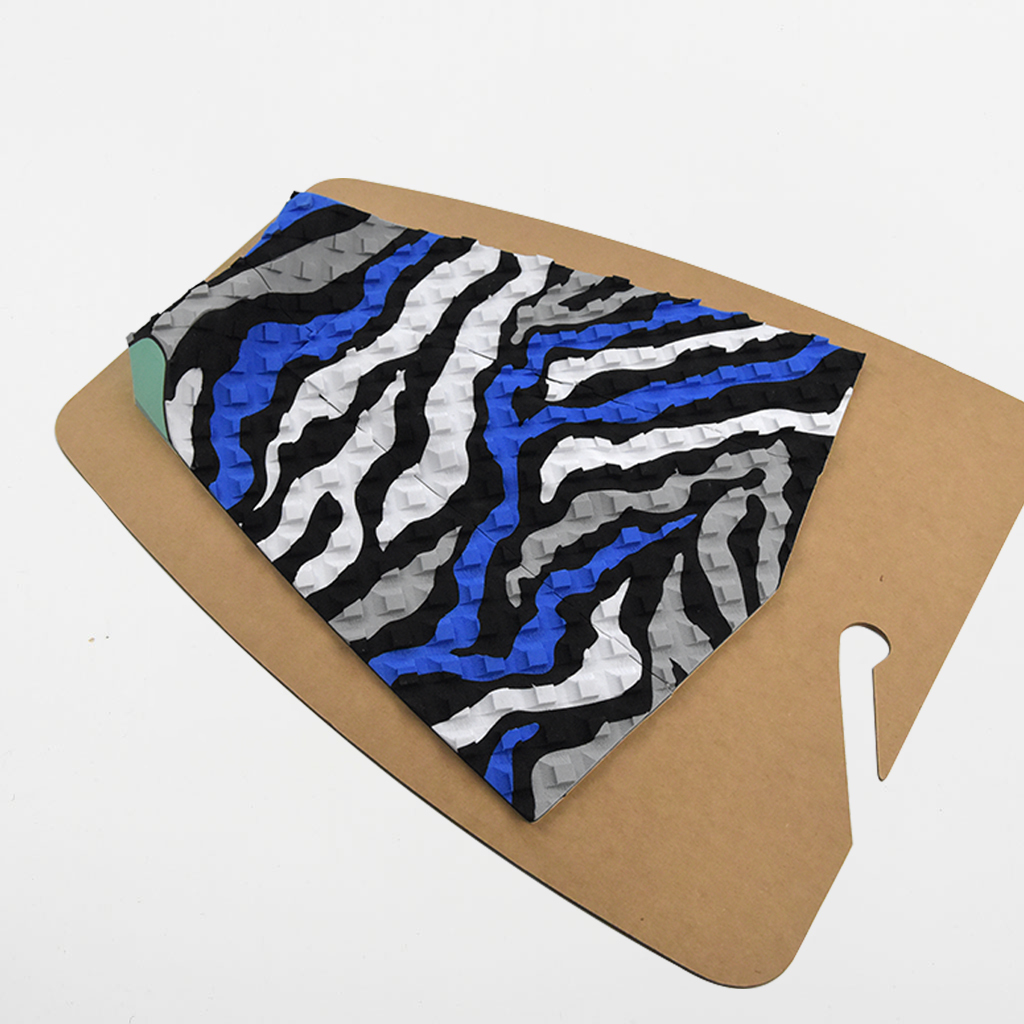
A surfboard tail pad does one job: it puts grip back under the back foot, on the part of the deck a rider drives through every turn. This one presses straight onto a clean deck, so a board with worn, flattened or lifting grip is back in the water after a simple peel-and-stick fit rather than a workshop job.
The surf traction pad is shaped for the tail rather than the whole deck. It leaves the front foot area free, gives the rider a fixed point under the back heel, and leaves the board's own flex and rocker untouched. A raised, textured surface and a slightly cushioned feel mean the foot reads the board through the pad instead of sliding across it.
Shops, schools and rental operators fit a tail pad for the same reason a rider does: it brings the grip back without changing the board's character. It suits shortboards and funboards, and a longboard traction pad set-up usually pairs it with a centre pad further forward, where a longer board is actually ridden.
Orders are placed by design, which is what makes the pad practical for a programme rather than a one-off. The same pattern can be repeated on the next order, carried across a whole set of boards, or developed into a private-label version for a distributor's own brand.
Grip and Underfoot Feel
- Raised, textured surface. The pattern gives the heel and ball of the foot something to push against, so the foot stays planted instead of skating across a wet deck.
- Cushioned where it counts. There is enough give in the pad to take the sting out of chop and hard landings without turning the tail into something soft and vague.
- Wet-foot grip. A surfboard traction pad only earns its place when it holds a wet foot, and this surface keeps its bite after a duck dive or a long paddle out.
- Feel through the turn. The pad stays low underfoot, so the rider can still tell where the tail is when the board is pushed hard through a bottom turn.
- Nothing to reapply. The grip is built into the surface, so there is no wax routine on the tail and nothing to melt in a hot car.
- Works across a mixed range of riders. The same pad suits a first-timer learning to stand up and an experienced surfer looking for more control off the tail.
- Built to stay on. The pad is made to hold its shape and its bond through regular saltwater use, rather than curling at the corners after a handful of sessions.
Fitting the Pad to the Deck
- Strip the old grip first. Work the worn pad up from a corner, take off as much of the old adhesive as you can, then wipe the tail down and let it dry completely.
- Check the position dry. Lay the pad on the deck with the backing still on and look at it from the tail: it should sit square to the stringer and clear the tail edge, the leash plug and the fin boxes.
- Mark the outline. A strip of tape down the centreline and a light mark at the front edge of the pad are enough to keep the surfboard tail pad straight once the backing comes off.
- Peel from the tail end. Expose a short section of adhesive, line the pad up on the marks and press that first section down before the rest is uncovered.
- Press out from the middle. Work across the pad with the flat of your hand, pushing air towards the edges instead of trapping it under the surface.
- Seat the whole outline. Run a thumb firmly around the edge, since that is where a pad lifts first when it is going to lift at all.
- Let it settle before the first session. A warm, dry room helps the adhesive take hold, so give the board time to sit before it goes back in the water.
- Peel warm and slow. An old surf traction pad comes off a sound deck cleanly; when a board is damaged during a refit it is nearly always the technique, not the pad. Warm the surface first with a hairdryer on its lowest setting, sweeping it across the whole pad so the adhesive softens evenly rather than one spot getting hot enough to blister the resin. Lift a corner, then pull back at a shallow angle, working close to the deck and letting the adhesive stretch and release. Slow and steady is what keeps the glass and foam underneath intact. Leave the metal in the toolbox. A steel scraper, a screwdriver or a knife blade turned on its edge is what digs into a deck. Use a plastic scraper or your thumb to start the corner, and if you do need a blade, keep it almost flat to the surface to lift an edge only. Never lever against the deck, the stringer, a fin box or the plug where the surf leash attaches — those are the spots that crack. Clear the fittings first. Take off anything that sits close to the tail before you start, and check that the old pad is not bonded over the leash plug recess or a fin box edge. If it is, soften that section for longer and lift it away instead of dragging it across the fitting. Deal with the residue properly. Leftover adhesive rolls off under a warm thumb far more easily than it scrapes off cold. A little mild solvent on a cloth finishes the job, but keep acetone and harsh thinners away from gloss coats and wood veneers. Wipe once, let the deck dry completely, and do not fit anything while the surface is still tacky from solvent. Know when to stop. Soft-top boards, EPS cores and wood veneer decks need a slower hand than a standard glassed tail, and a deck that has spent seasons face-up in the sun may release glass fibres with the pad. If you feel the surface lift under your fingers, stop and let a repair shop look at it before a new pad goes down. The same care applies to the forward area if you are also replacing a longboard traction pad. Check the deck before refitting. Run a hand over the cleared area for high spots, cracks or damp patches, and give any exposed foam time to dry and be sealed. Dry-fit the new surfboard tail pad before the backing comes off, and only then press it down onto a warm, bone-dry deck.
Consistency Across a Board Set
A fleet is where a pad design earns its keep. Schools and rental operators run boards that are used daily, repaired in batches and retired one at a time, and a set carrying the same grip is far easier to manage than a collection of mismatched pads. Staff can move a pad from a retired board to a live one, or replace a single worn pad, without the board looking patched together. The same logic holds on a shop floor. Boards lined up on a surfboard rack with matching grip read as one range rather than an assortment of leftovers, and a customer comparing two sizes sees the same deck treatment on both. A surfboard traction pad is a small thing to hold in stock, so keeping two or three spares in the fleet design means a repair never waits on an order. The pad becomes a line item you reorder by name, not a photograph somebody has to match by eye.
Care and Replacement
- Expect wear, not failure. A surf traction pad takes the same beating the deck does, and treating it as a part that gets replaced after a few seasons is what keeps a board's grip consistent.
- Rinse after saltwater. Fresh water lifts salt and sand out of the texture before it dries in and dulls the surface.
- Keep solvents away. Harsh cleaners and acetone-type products attack the adhesive at the edges and strip the finish off the texture.
- Do not bake it. A board left deck-up in strong sun for a long stretch gets hot enough to soften the bond, so shade or a board bag is the safer habit.
- Clean up to the outline. Scrape and comb the waxed deck area around the pad rather than dragging a comb across the texture, which is what clogs it.
- Watch the edges. A corner that starts to lift is worth pressing back down straight away, before salt and sand get underneath it.
- Read the wear signs. A surface that has gone smooth and shiny, a flat spot under the heel, or an edge that lifts again after being pressed down all point to a replacement.
- Store boards sensibly. Stacking boards flat on top of one another puts weight on the pad and flattens the texture over time.
Companion Accessories
Most orders leave as one consignment, so it helps that the pads sit alongside the rest of the water kit. Leashes run from a 6 ft 6 mm Hypalon model for small to medium waves through 7 ft and 8 ft versions up to a 9 ft 8 mm longboard leash for bigger surf, with regular, non-slip strap, Hypalon strap, bodyboard and SUP options. Matching the surf leash to the board it goes on is the usual starting point, and every surfboard leash is offered in the lengths and gauges that suit the boards you stock.
Fins follow the same logic. The range covers honeycomb, timber, G10 glass and nylon constructions, with single tab and double tab options and fin accessories for the shop bench. Stocking surfboard fins next to the pads lets a shop present a board as a ready-to-ride package rather than a bare deck, and gives the customer one place to come back to when a fin goes missing.
Traction itself is a range rather than a single item: tail pads, centre pads, skimboard pads and waxless pads. A longboard traction pad set-up often runs this tail pad plus a centre pad, while a skimboard or bodyboard rider takes a different shape again, so the assortment can be built around the boards you actually sell.
Covers and racks finish the picture. Covers run from a basic bag to a regular bag, a stretch cover and a bodyboard bag, and a surfboard rack covers wall display, storage, travel tie-downs and bike versions. Between them, a shop can fit out a wall or a van, and a school can keep boards protected in transit, all from the same supplier.
Specifications
| Property | Detail |
|---|
| Product type | Tail pad for surfboard deck traction |
| Placement | Tail area of the deck, under the back foot |
| Attachment | Self-adhesive backing |
| Surface | Raised textured grip with a cushioned feel |
| Use | Back-foot traction through turns and cutbacks |
| Suits | Shortboards, funboards, longboards and rental fleets |
| Deck coverage | Tail only; centre pads cover the forward area |
| Design reference | No.00564 |
Ordering and Delivery
- Design confirmation. Send the pattern you want, or a photo of the pad you are replacing, and we will match it against the range before anything is scheduled. - Samples. Ask your sales contact about sample availability and the current terms before a range is signed off. - Quantities and dates. Tell us the volume and the week you need it in store; quantity breaks, production slots and lead time are confirmed on the quotation rather than assumed. - Private label. The pads can be produced under your own branding, with deck pattern, colourway and packaging agreed before production starts. - In-store presentation. Confirm whether your stores need hangers, barcodes or shelf-ready cartons, so packaging is planned together with the order. - Mixed consignments. Ask for the whole accessory list to be quoted together rather than item by item; pads, surfboard fins and covers usually ship in the same season. - Leash matching. Tell us the board lengths in your range and we will confirm the surf leash lengths to stock alongside the pads. Getting that pairing right is what keeps a surfboard leash from sitting unsold on the shelf. - Shop fitting. If you are equipping a store or a school, a cover or a surfboard rack can go on the same quotation as the pads. - Repeat supply. - Direct from the maker. Orders are handled by the surf board manufacturers who produce the pads rather than a reseller, so a design change or a repeat stays with the same team. - Terms and documents. Payment terms, shipping terms and paperwork are set out on the quotation for your confirmation.
Scale & Supply Capability
CIMI is a factory-based supplier with 16 years in surf and watersports hardgoods, manufacturing at our own facility rather than sourcing through traders. Chain stores, supermarkets and surf-brand stores buy from us because one supplier covers a full accessory assortment, so a season's order and its reorders can be planned together. We take on OEM and private-label work, adapting designs, colourways and branding to your programme, and we schedule production against your agreed range plan. Send us your buy list and target dates, and we will confirm what we can make and when.
FAQ
Will these pads fit my board?
A surfboard tail pad is shaped for the tail area, so it works on shortboards, funboards and longboards wherever there is a reasonably flat section behind the back foot. Measure the width of the tail where the pad will sit and compare it with the pad outline before ordering; on a very narrow, heavily channeled or stepped tail, check the footprint with us first. A surfboard traction pad that overhangs the rail will lift at the edge, so the fit matters more than the pattern.
Do I need a centre pad as well as a tail pad?
Not on a shortboard. On a longer board, most riders run this pad under the back foot and add a centre pad or a longboard traction pad further forward, so the deck is covered wherever the feet land when the rider walks the board. If you are building one set-up for a school or a rental fleet, the tail pad plus a centre pad is the combination that suits the widest range of riders.
Can I remove an old pad and fit a new one myself?
Yes, and the deck usually comes up clean if you take your time. Warm the old pad gently rather than forcing it, peel slowly from a corner, and clean off the leftover adhesive before the new surf traction pad goes down. Work in a warm, dry space and let the deck dry completely, because adhesive will not bond to a damp or dusty surface.
Can the range be made under our own brand?
Yes. Private-label work is part of what we do as surf board manufacturers: deck pattern, colourway, logo and packaging are agreed to your brief before production, and the same specification is held on file for repeat orders. Send the artwork and the packaging format you want and we will confirm what is possible.
Will fitting a pad interfere with fin boxes or the leash plug?
No. The pad sits on the deck surface behind the back foot and does not touch either, but it does need to clear them, so check the outline against both before the backing comes off. If you are fitting a surf leash at the same time, leave the plug clear of the pad edge. A surfboard leash fitted through the plug is unaffected by the pad. Surfboard fins sit in their boxes as before, well clear of the tail area.