Product Overview
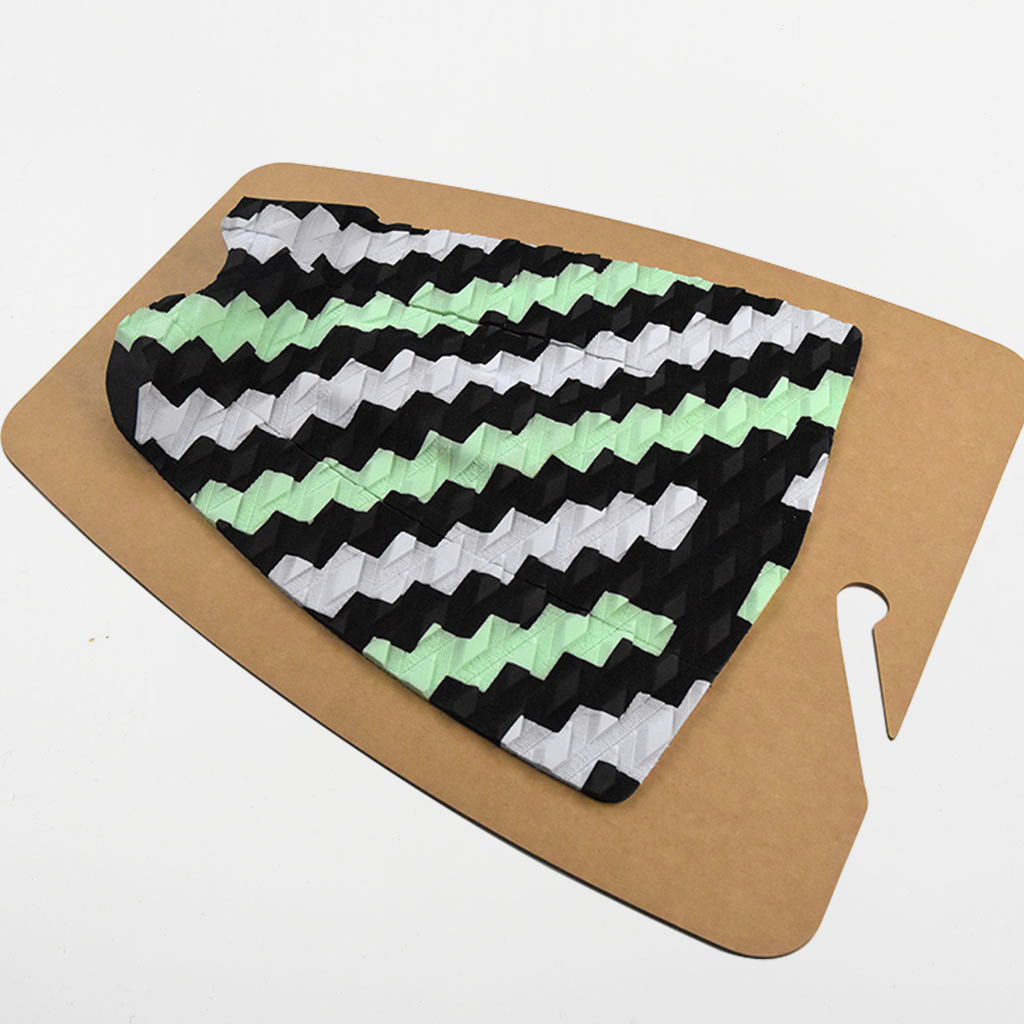
No.00555 is a tail pad: a die-cut piece of cushioned deck grip that sits on the back of a surfboard, under the rear foot. That is the area a rider loads hardest to turn, and it is also the area that goes smooth and lifts at the edges first. Fitting this surf traction pad puts a fresh textured surface and a new adhesive backing back where the board needs them.
The job itself is quick. The pad arrives with a peel-and-stick backing, so fitting comes down to a clean, dry deck, a test fit that lines the outline up with the tail, and a firm press from the middle outwards. Most shops do it at the counter between other jobs, and a rental operation can work through a stack of boards in an afternoon.
Each pad in this range is a single pattern with its own reference, and this one is no exception. That matters more than it sounds. A shelf of pads that all look alike sells one pad; a shelf of distinct patterns sells across the range, and the reference is what makes a repeat order land on the same item instead of a near-match. It is also why this design is usually bought alongside a surf leash and the rest of the accessory wall rather than on its own.
In daily use the pad behaves as a wear item rather than a permanent fixture. Schools and rental fleets change theirs at the start of a season; a shop changes one when a customer's old pad starts to lift. Stocked to that rhythm, it is a small, fast-moving line that sits beside the boards rather than competing with them.
Key Features
- Grip where the back foot drives — the raised pattern gives the rear foot something to push against through a turn, the same pressure that loads the surfboard fins underneath.
- Cushioned underfoot — a padded layer between foot and deck takes some of the sting out of repeated turns and keeps the back foot planted instead of skating across the tail.
- Peel-and-stick fitting — no resin and no clamps: the backing comes off, the pad presses onto a clean deck, and the board is ready once the adhesive has settled.
- Die-cut outline — every surfboard tail pad in the range is cut to follow the shape of a tail rather than left as a rectangle that has to be trimmed by hand.
- Texture that stays raised — the pattern keeps its bite under a wet foot and does not polish smooth the way a waxed deck does after a long session.
- Built for regular use — the surface is made to stand up to daily sessions, so the pad holds its texture instead of going slick after a few weeks.
Fitting & Installation
- Set the board on a surfboard rack at working height and strip the old grip completely — lift the worn pad, scrape off the residue, and let the deck dry. A new pad laid over old adhesive will lift at the same edges within weeks.
- Test-fit before you peel anything. Set the pad on the tail and sight down the board; with a longboard traction pad most fitters push it as far back as the tail curve allows.
- Mark the position with tape — two strips down the sides and one across the back edge — so you have a target to drop the pad into once the backing is off.
- Clean the deck and let it flash off. Dust, wax and sunscreen all stop the adhesive bonding, so fit indoors or in the shade rather than in cold, damp air.
- Peel a short section of backing first, tuck that edge inside your tape marks, then work along the surfboard tail pad pressing from the centre outwards so trapped air has somewhere to go.
- Roll the whole pad down by hand or with a roller, then leave it to settle before the board goes back in the water.
Companion Accessories
- Leashes — regular, non-slip and Hypalon straps in ankle and SUP lengths; a surf leash is the accessory bought most often with a pad, because both take their hardest wear at the tail end of a board.
- Fins — honeycomb, timber, G10 glass and nylon surfboard fins plus fin accessories, so a shop can send a board out re-gripped and re-finned in the same visit.
- Traction — this surfboard traction pad belongs to a wider family of tail pads in many patterns, plus centre pads, skimboard pads and waxless pads for riders who would rather not wax at all.
- Covers — basic bags, regular bags and stretch covers for day-to-day transport and for boards travelling in a van or on a roof.
- Racks — travel rax and tie-downs, storage racks, display racks and bike racks, so a surfboard rack is available whenever a shop refits its board area.
Specifications
| Product type | Surf traction pad |
| Reference | No.00555 |
| Placement | Tail of the deck, under the back foot |
| Fixing | Peel-and-stick adhesive backing |
| Surface | Cushioned, textured grip |
| Outline | Die-cut tail pad shape |
| Design | One pattern from a wider tail pad range |
| Deck types | Shortboard, longboard and hybrid tails |
| Supplied as | Individual pad, ready to fit |
Care & Replacement
A tail pad needs little looking after, but three habits decide whether it lasts one season or three. The first is fresh water: a rinse after every session takes salt and sand out of the pattern before either works its way under an edge. The second is shade — a board left in a hot car or standing in the sun all day softens the adhesive, and a lifted corner is the beginning of the end.
Clean the surface with mild soap and water when it looks grey, and skip solvents, acetone and hot water, which dull the raised pattern and can attack the backing. A soft brush is enough for packed sand; a pressure washer aimed at the edge is not.
Watch for the signs that a replacement is due — edges standing proud of the deck, the pattern flattened where the heel sits, or the back foot sliding out of a bottom turn. On a longboard traction pad the wear point is usually the very back, where a dragged foot lands, and it goes smooth before the rest of the pad does.
Between sessions, store the board clean and dry on a surfboard rack rather than leaning it on its tail in a corner where the pad takes the weight. If boards are stacked, keep the pad side up and let nothing rest on it.
Private Label & Colourways
- The pattern is the starting point — every design in the range, this one included, can be carried into a brand's own programme, so the deck pattern you see here is a base rather than a fixed item you can only buy as shown. - Colourway is the main lever — deck colour, pattern colour and the way the two sit against each other are worked out from your palette, so a surf traction pad made for your line reads as yours on the shelf instead of as a stock item. - Branding goes where the buyer looks — logo on the pad surface, on the backing sheet the customer peels off, or on the header card and hang tag; placement is agreed with you because it changes how the pad presents in store. - What stays the same — the die-cut outline, the cushioned textured surface and the peel-and-stick backing. Those are the parts that make it work as a surfboard tail pad, so customisation works around them rather than through them. - Start from the range, not a blank sheet — pick the pattern closest to the look you want and change from there; it shortens development and keeps your line inside a family of designs that already sell together as a surfboard traction pad assortment. - Packaging carries the brand too — header cards, hang tags and printed backing sheets can all carry your identity, which is often what separates a private-label pad from a lookalike on the next shelf.
Ordering & Delivery
- Pin the design down first. If you are restocking an item already on the shelf, send a photo of the pad you are replacing and we will match it to the closest pattern in the current range.
- Build the whole list in one go — pads, a surf leash, covers and racking can travel on the same order, which keeps a single delivery date and one set of documents instead of four.
- Add the fin line if you stock it. Surfboard fins and fin accessories come from the same catalogue, so they can be quoted on the same sheet as the pads.
- Say what the pads are going into — a hanger, a counter unit or a private-label programme — because each one changes how they are packed and marked.
- Confirm quantities, delivery date, packing and payment terms with your sales contact before production is scheduled. Nothing is fixed until that confirmation comes back to you in writing.
- Keep the reference list. Reordering by reference is quicker than re-describing a pattern, and it is how the chains we supply keep a shelf consistent from one season to the next.
Scale & Supply Capability
CIMI is a factory-based supplier with 16 years in surf and watersports hardgoods, manufacturing at our own facility rather than sourcing through traders. Chain stores, supermarkets and surf-brand stores buy from us because one supplier covers a full accessory assortment, so a season's order and its reorders can be planned together. We take on OEM and private-label work, adapting designs, colourways and branding to your programme, and we schedule production against your agreed range plan. Send us your buy list and target dates, and we will confirm what we can make and when.
FAQ
Will this pad work on a longboard as well as a shortboard?
Yes. The outline is cut for the tail area, and a longboard traction pad is usually fitted as far back as the tail curve allows so the rider keeps the pivot point under the back foot. Boards with a very wide or square tail can take a broader outline — send us the tail width and we will point you to the patterns in the range that fit that tail shape. Riders who want grip further forward normally add a centre pad rather than a second pad at the back.
Do I still need wax once the pad is on?
Not on the covered area — the pad is the grip. Keep wax off the surf traction pad entirely, because wax fills the raised pattern and the pad ends up as slippery as a bare deck. Wax the rest of the board as usual and stop the wax line a couple of centimetres short of the pad's edge so it does not creep underneath.
Can I lift the pad and re-position it if I set it down crooked?
A surfboard traction pad is a fit-once item. The adhesive grips the deck firmly once pressed, and lifting it again usually takes some of the backing with it, so getting the alignment right the first time is worth the extra minute. Peel only a short section of backing, set that edge inside your tape marks, and check the line before pressing the rest down. If a corner is out while the backing is still partly on, lift that corner and reset it.
What about a board with a narrow or heavily rounded tail?
On most shortboard and hybrid tails the pad seats cleanly. Narrow pintails and very rounded tails are the cases worth checking before you order: send a photo of the tail from above, or a tracing of the outline, and we will tell you whether this pattern covers the area properly or whether a different shape in the range is the better fit.
Can the pattern be supplied in our own colourway?
Yes. Colourway and branding changes are part of the private-label work we do as surf board manufacturers. Send the palette you are working to and the pattern you like, and we will confirm what can be done on that outline and how a colour change reads against the deck pattern.